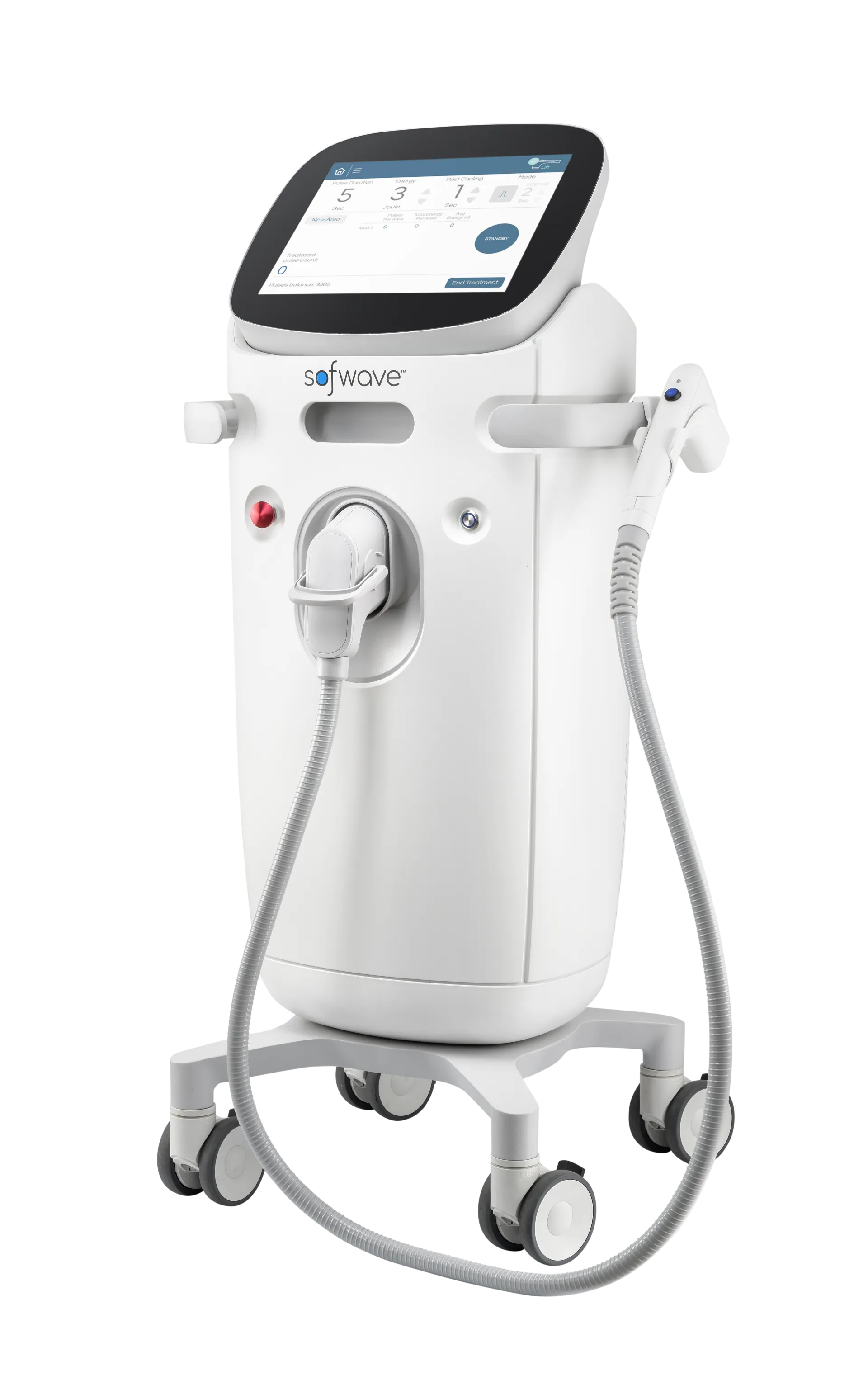
How Sofwave SUPERB Technology Works
Sofwave uses Synchronous Ultrasound Parallel Beam (SUPERB) technology to deliver focused ultrasound energy to the mid-dermis. Unlike single-point focused ultrasound systems, SUPERB generates 3 parallel cylindrical beams that create a uniform thermal zone at precisely 1.5mm depth. Each beam heats dermal collagen to 60-70 degrees Celsius, triggering immediate protein denaturation and subsequent neocollagenesis over the following 12 weeks.
The integrated Sofcool cooling mechanism maintains epidermal surface temperature below 40 degrees Celsius throughout the procedure. This 7-layer cooling array prevents thermal injury to the epidermis while allowing precise energy delivery to dermal targets. The parallel beam architecture treats a 46mm x 46mm area per pulse, covering the full face in approximately 200-400 individual pulses delivered over 30-45 minutes.
FDA Clearance and Regulatory History
510(k) Clearance Timeline
Sofwave received its initial FDA 510(k) clearance (K191568) in November 2019 for lifting the eyebrow. Subsequent clearances expanded indications to include submental tissue tightening in 2020 and improvement of facial lines and wrinkles in 2021. Each clearance required submission of clinical safety data demonstrating the device meets predicate equivalence standards for non-invasive dermal heating devices. The CE mark for European distribution followed in 2020.
Safety Classification
As a Class II medical device, Sofwave falls under FDA product code QKO for ultrasound-based tissue heating. The 510(k) pathway requires demonstration of substantial equivalence to legally marketed predicate devices rather than the more rigorous premarket approval (PMA) process. This classification reflects the device's established safety profile within the broader category of non-invasive aesthetic ultrasound systems.
Clinical Evidence for Sofwave Efficacy
A prospective multicenter study involving 67 subjects demonstrated statistically significant improvement in facial wrinkle severity at 12 weeks post-treatment. Researchers measured a mean improvement of 1.2 points on the Fitzpatrick Wrinkle Severity Scale across all treatment zones. The study reported 95% patient satisfaction with no device-related serious adverse events. Brobst RW et al. Aesthet Surg J. 2021;41(3):NP93-NP98. doi:10.1093/asj/sjaa268
A split-face comparative trial evaluated Sofwave against sham treatment in 48 subjects aged 35-65. The treated side showed a 73% responder rate at 6 months versus 12% on the sham side. Histological analysis confirmed a 27% increase in dermal collagen density at the 1.5mm target depth. Goldie K et al. J Cosmet Dermatol. 2023;22(4):1148-1155. doi:10.1111/jocd.15564
Mechanism of Collagen Remodeling
The thermal injury created by Sofwave at 60-70 degrees Celsius initiates a 3-phase wound healing response. The inflammatory phase begins within hours as heat shock proteins HSP47 and HSP70 activate dermal fibroblasts. During the proliferative phase spanning weeks 2-8, fibroblasts synthesize type I and type III procollagen at rates 2-3 times baseline levels. The remodeling phase continues through month 6 as immature type III collagen converts to mature type I collagen with organized cross-linking.
Sofwave's 1.5mm target depth places the thermal zone within the papillary and upper reticular dermis, where the highest concentration of collagen fibers responsible for skin firmness resides. This differs from deeper-targeting devices like Ultherapy (4.5mm, SMAS layer) and positions Sofwave as a complementary technology rather than a replacement. RE:BERRY Myeongdong protocols combine both depth levels for comprehensive tissue remodeling across all dermal layers.
Sofwave Compared to Other Ultrasound Technologies
Three primary ultrasound-based aesthetic technologies target different tissue depths. Sofwave operates at 1.5mm (mid-dermis), Ultherapy at 1.5-4.5mm (dermis to SMAS), and HIFU devices at 3.0-4.5mm (deep dermis to SMAS). The SUPERB parallel beam configuration distinguishes Sofwave from single-point focused systems by delivering energy across a wider treatment plane with more uniform heating. Treatment time for a full face averages 30-45 minutes for Sofwave versus 60-90 minutes for Ultherapy, with reported pain scores of 2-4 versus 4-6 on a 10-point visual analog scale.